Sexual Response in Women

A Poster Presentation by Athena Institute
at the American College of Obstetricians and Gynecologists 2000 meeting.
More on pheromones and books from Athena Institute
Authors:
Winnifred B. Cutler, Ph.D., President and Founder, Athena Institute for Women's Wellness
Norma L. McCoy, Ph.D.,Professor of Psychology, San Francisco State University, SFO, CA
Millicent G. Zacher M.Ed.,D.O., F.A.C.O.G.,Director, Div of Reproductive Endocrinology, Albert Einstein Medical Center, Phila. PA
Elizabeth Genovese M.D.,Medical Director, IMX, Bala Cynwyd, PA
Erika Friedman, Ph.D. Professor of Biology, Chair, Dept Health and Nutrition Sciences, Brooklyn College, Brooklyn, NY
May, 2000. The American College of Obstetricians and Gynecologists (ACOG) held its 48th Annual Clinical Meeting (ACM) in San Francisco, CA.,at the Moscone Convention Center. The meeting began Monday, May 22 and ran through Wednesday, May 24. ACOG is a national medical organization which represents over 40,000 obstetricians and gynecologists throughout the United States. ACOG’s ACM is one of the largest gatherings of women’s health care practitioners, drawing thousands of physicians, experts, poster exhibitors, researchers, and guests.
More info about this meeting.
Abstract:
Objective:
This research examined the sexual activity, frequency, and orgasmic experience in: a) 132 women with an intact uterus undergoing assessment in the Athena Institute's women's wellness program; b) 37 other patients with uterine fibroid tumors; and c) 23 women from the wellness program who had had a hysterectomy.
We compared these data to recently published data on sexuality for women before hysterectomy1 and for women from the wellness program who had had a hysterectomy.
Methods:
Consecutive patients undergoing comprehensive executive physical exams were offered perineometry tests of pubococcygeal muscle strength and endurance and asked to complete extensive questionnaires on genitourinary experience of incontinence and sexual response including coital and orgasmic frequency. Women using either oral contraceptives or Prozac were excluded from our final data analysis because of recent studies showing sexual response deficiencies in these groups2,3. Informed consent was obtained to use their data. An unaffiliated gynecologist provided the same questionnaires to the 37 patients with fibroid tumors who mailed them to Athena Institute.
Results:
Confirming prior reports, clitoral and vaginal sites were commonly recognized as sites contributing to orgasm. A third site--the cervix---was reported by a substantial minority of women. Both study groups showed similar responses. Cervical stimulation was recognized as making a contribution to orgasm by 46% of the wellness program women and 70% of the fibroid patients. Vaginal stimulation was recognized in 86% and 91% respectively. Clitoral stimulation was reported in 98% and 97%.
Although pelvic muscle strength and endurance had previously been shown to be inversely related to incontinence4 neither was related to these sexual findings. Parity also was an independent factor; multiparous women were more sexually responsive than primiparas or nulliparas.
Women who were scheduled for hysterectomy showed both a statistically and clinically significant reduction in sexual activity and orgasm compared to other women.
Conclusions:
Most women reported that clitoral stimulation evoked their orgasms; many women also recognized that vaginal stimulation would; fewer also perceived that cervical stimulation could contribute to their orgasm.
More women with fibroid tumors reported being sexually responsive than intact well women at the vaginal and cervical sites.
Probably, hysterectomy negatively impacts sexuality. We found intact well women more sexually active and orgasmic than women scheduled for surgical removal of the uterus. Recent studies1,5 using the preop period as a baseline have employed a distorted i.e., suppressed prehysterectomy measure of sexuality; those studies incorrectly compared posthysterectomy sexuality at 2 years to support an invalid conclusion that hysterectomy "improves" a woman's sexuality.
Multiple child bearing appeared to improve perceived sexual responsiveness at vaginal and cervical sites.
Figure 1: The Athena Institute questionnaire on Orgasm
How often during sexual intercourse do you reach orgasm ?
------- ------- ------- ------- -------
never rarely occasionally frequently always
Please indicate which of the following forms of stimulation enable you to reach orgasm. (check all that apply)
____ clitoral stimulation alone
____ vaginal stimulation alone
____ cervical tapping (penis tapping at base of uterus) alone
____ clitoral and vaginal stimulation
____ clitoral stimulation and cervical tapping
____ vaginal stimulation and cervical tapping
____ all these types of stimulation
Please indicate how often each type of stimulation contributes to orgasm
clitoral stimulation
------- ------- ------- ------- -------
never rarely occasionally frequently always
vaginal stimulation
------- ------- ------- ------- -------
never rarely occasionally frequently always
cervical tapping
------- ------- ------- ------- -------
never rarely occasionally frequently always
Date of Birth:_________________
Figure 2: Age distribution of the Intact Wellness, Intact Uterus with Fibroid Group, and Post Hysterectomy Wellness Patients
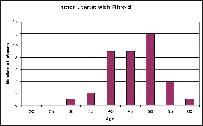
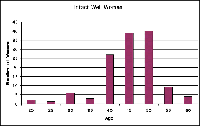
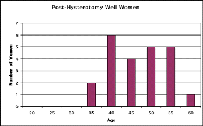
Mean ages for 132 intact women (M = 47.0, SD = 7.1)
37 women with fibroids (M = 48.3, SD = 6.4),
and 23 women who had had a hysterectomy (M = 48.7, SD= 7.2)
were not significantly different (F < 1)
Background
Sexual stimulation of the clitoris is well established as a trigger for orgasm for most women. Vaginal stimulation also has been reported to trigger orgasmic inevitability if the rhythm and pressure are individualized6.
Work in rats has established a significant role of cervical stimulation in triggering hypothalamic-pituitary neural pathways that trigger GNRH release. Work in spinal-injured women with intact uteri has demonstrated that cervical and vaginal stimulation applied differentially triggered disparate orgasmic perceptions in these women7.
Recent studies of women immediately before, and up to 2 years after, their hysterectomy have concluded that the increase in several measures of sexual behavior that they reported provide evidence that hysterectomy improves the sexual life of women1,5. Unfortunately, this seemingly welcome conclusion could be marred by a faulty choice of baseline for comparison to the postoperative era, and the omission of a comparison group of intact women.
We arrayed the most widely cited pre and post hysterectomy data1 and compared them to our samples of well women, and women with fibroid tumors. Our Tables 1, 2, and 3 demonstrate that presurgery sexual life is depressed in comparison with all other groups studied. Hence, the studies purporting to describe a posthysterectomy improvement in sex life are crippled by their defective choice in baseline. If questions are asked about her recent sexual behavior, AFTER a woman has agreed to be scheduled for a hysterectomy, one can expect to learn she is not very sexual just before genital surgery.
Influences of parity were previously suggested for sexual arousal and orgasm8. The anatomical and physiological changes of pregnancy and parturition, and the related variations in sexual arousal were initially described by Masters and Johnson. Therefore, it was relevant to search for an influence of parity on the measures of sexual arousal being reported here.
Fibroid tumors had not previously been studied for their relationship to sexual response. However, the earlier reports8 of the role of uterine engorgement on sexual arousal and orgasm imply a potential enhancement of sexual response in women with fibroid tumors.
Results:
Table 1: Proportion of Women Reporting They Are Sexually Active
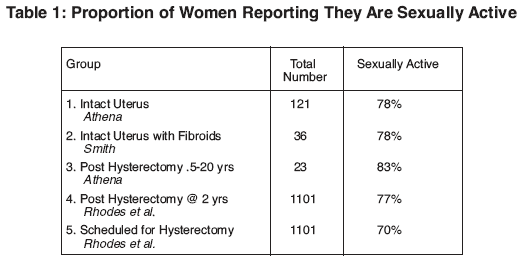
A significantly lower proportion of women are sexually active before their hysterectomy than two years later1.
Table 2: Proportion of Women Reporting Frequent Sexual Activity
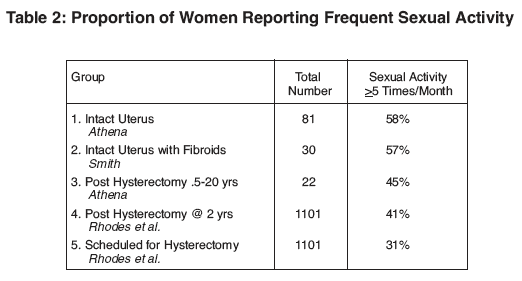
Comparison of women reporting frequent sexual activity was tested for Groups 1,2,3,and 5. X2(3,N = 1234) = 33.87, p <. 005.
Because Groups 4 and 5 are the same women, they are not independent, and therefore group 4 was excluded from comparisons.
A significantly lower proportion of women are FREQUENTLY sexually active before their hysterectomy than themselves two years later1, or than women with fibroid tumors (X2(3,N = 1234) = 9.0, p < .025) or women with an intact uterus X2(3,N = 1234) = 25.5, p < .0005.
Table 3: Proportion of Women Reporting Frequent Orgasm
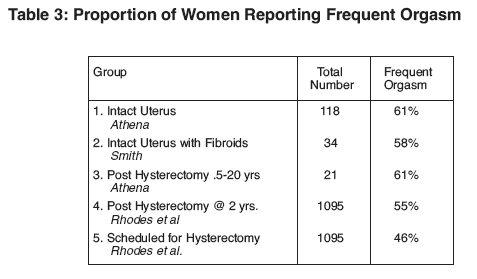
Comparison of women reporting frequent orgasm was tested for Groups 1,2,3,and 5. X2(3,N = 1268) = 13.76, p < .005.
A significantly lower proportion of women are frequently orgasmic before their hysterectomy than intact well women (X2(3,N = 1268) = 10.19, p < .01) or than themselves two years after hysterectomy1.
Table 4: How Often Each Type of Stimulation Contributes to Orgasm among Intact Well Women
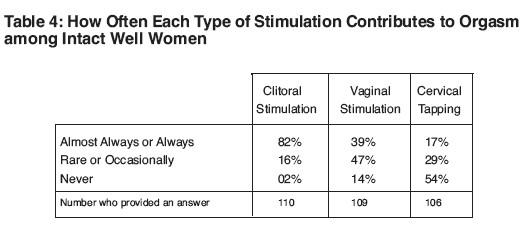
Clitoral stimulation is the most commonly perceived form of stimulation contributing to orgasm, vaginal stimulation the next most common, and cervical tapping the least common.
Table 5: Frequent Contribution to Orgasm by Site
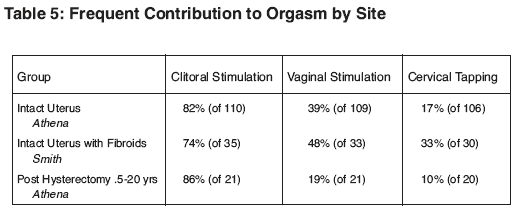
Hysterectomy appears to compromise sexual sensitivity at both the vaginal and cervical sites. Comparison of the frequency of women reporting that vaginal stimulation frequently contributed to orgasm revealed differences among the three groups of patients.
Women with fibroid tumors appear to experience a heightened vaginal sensitivity. X2(2,N = 163) = 4.08, p < .07.
Similar analysis for cervical sensitivity also revealed a significant difference X2(2,N = 156) = 5.29, p < .05.
Table 6A: Recognition of a Contribution to Orgasm by Site in Relationship to Parity among Intact Well Women
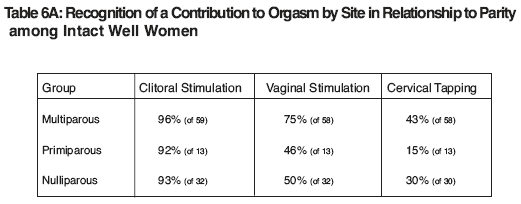
Percentage of women who recognize that during their coital activities this form of stimulation contributes to orgasm.
Comparison of the frequency of women reporting that vaginal stimulation contributed to orgasm revealed differences among the three groups of patients (for vaginal sensitivity, X2(2,N = 103) = 8.04, p < .001.
Similar analysis for cervical sensitivity also revealed a trend toward a significant difference X2(2,N = 101) = 4.15, p < .07.
Multiparous women appear to be more sensitive to vaginal and cervical stimulation than primiparous and nulliparous women.
Table 6B: Frequent Contribution to Orgasm by Site in Relationship to Parity among Intact Well Women
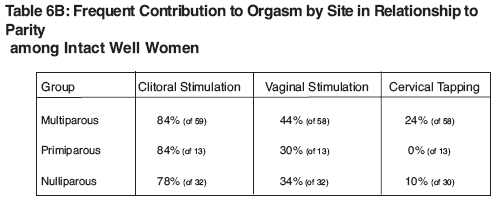
Percentage of women who record that coital stimulation frequently contributes to their orgasm at specified anatomical site. Comparison of the frequency of women reporting that cervical tapping stimulation frequently contributed to orgasm revealed differences among the three groups of women.
Significantly more multiparous women experienced frequent orgasms from cervical tapping than nulliparous or primiparous X2(2,N = 101) = 5.80, p < .05.
Conclusion and References
Conclusion
1) These data suggest a hierarchy of sites for sexual response. Most women recognize that clitoral stimulation evokes orgasm. Many of these recognize vaginal stimulation, with a smaller proportion recognizing cervical stimulation.
2) Women with fibroid tumors are more sexually responsive, at the vaginal site and appear more sexually responsive at the cervical site, than intact well women.
3) Hysterectomy can be expected to impact sexuality. Contrary to previous assertions, our data contradict the conclusion that hysterectomy enhances the sexuality of women. The sexual lives of women who have been scheduled to undergo a hysterectomy were depressed compared with intact women; and according to Rhodes, et al., themselves posthysterectomy. Our data indicated that intact well women were more sexually active and more sexually responsive than women scheduled for hysterectomy.
Thus, we conclude that the data collected in the last 30 days before hysterectomy cannot provide a valid measure of prehysterectomy sexuality. The data from several recent studies1,5 that compared post-hysterectomy sexuality to that period immediately preceding surgery are not valid indicators of the effects of hysterectomy on sexuality.
4) The event of multiple child bearing appears to enhance the ability to respond sexually.
References:
1. Rhodes JC, Kjerulff KH, Langenberg PW, Guzinski GM (1999) Hysterectomy and sexual functioning. JAMA 282:1934-1941
2. McCoy NL and Matyas JR (1996) Oral contraceptives and sexuality in university women. ArchSexBehav 25:73-90.
3. PROZAC (fluoxetine HCL) prescribing information by Dista/Eli Lilly, pp. 859-863, PHYSICIANS DESK REFERENCE 52nd Ed (1998), Medical Economics Company, Inc. Montvale, NJ 07645.
4. Cutler WB, Friedmann E, Genovese-Stone E, and Felmet K (1992) Urinary stress incontinence: a pervasive problem among well women. J Wmns Health Vol 1:259-266.
5. Carlson KJ, Miller BA, Fowler FJ (1994) The Maine Women's Health Study: I. Outcomes of hysterectomy. Obstet Gynecol 83:556-65.
6. Alzate H (1985) Vaginal eroticism: a replication study. ArchSexBehav 14:529-537. and for example, Alzate H (1985) Vaginal eroticism and female orgasm: a current appraisal Journal of Sex and Marital Therapy 11:271-284.
7. Komisaruk B, Whipple B (1986) Vaginal stimulation - produced analgesia in rats and women. Annals NY Acad. Sciences 467:30-39. and Komisaruk BR, Gerdes C, Whipple B (1997) Complete spinal cord injury does not block perceptual responses to genital self stimulation in women. Archives of Neurology 54:1513-1520.
8. Master WH and Johnson VE (1966) Human Sexual Response Little, Brown, Boston
RELATED INFORMATION ON ACOG: Visit www.acog.org
" My research has consistently focused on what behavior a woman can engage in to increase her power, well-being, vitality."
---Winnifred B. Cutler, Ph.D.
For More Information on Sexual Response and Hysterectomy; review Dr. Cutler's book, Hormones and Your Health (click here)